Research
Our lab uses the amazing axolotl as a model to understand the biology of gravisensation. All species large enough to be affected by the constant pull of the force of gravity have evolved ways to sense it and orient themselves with respect to it. In humans and other tetrapods, our sense of gravity relies on tiny, biomineralized crystals called otoconia in specialized chambers in our inner ear. When these calcium carbonate crystals degrade or dislocate from the inner ear compartments, they can cause a variety of balance disorders including the most common type of vertigo (BPPV). Axolotls not only have highly conserved inner ear structure but also show the fantasic ability to regenerate these crystals if removed. Understanding how the axolotl can regenerate these structures and restore its correct sense of balanace on a molecular, cellular, structural and organismal level is the main goal of the Czarkwiani Lab.Biomineralization of otoconia in axolotl development and regeneration
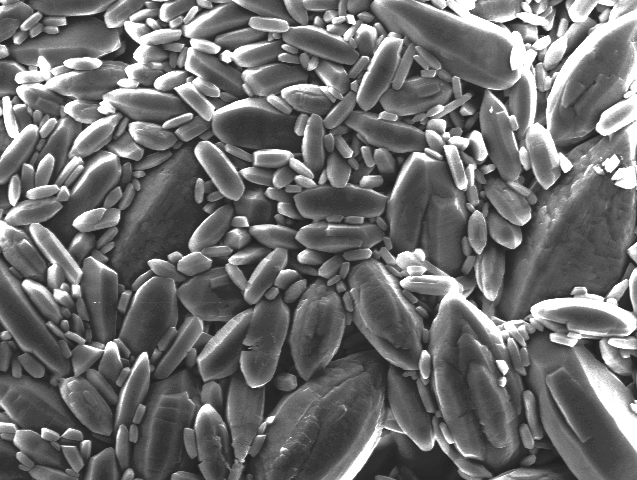
Using biomaterial approaches we will study the inorganic phase of the otoconia in the axolotl. SEM and microCT imaging will be used to characterise the appearance of otoconial crystals. Spectroscopy techniques such as FT-IR will be used to determine their biophysical and biochemical properties such as calcium carbonate polymorph state.
Otoconia biomineralization gene regulatory network
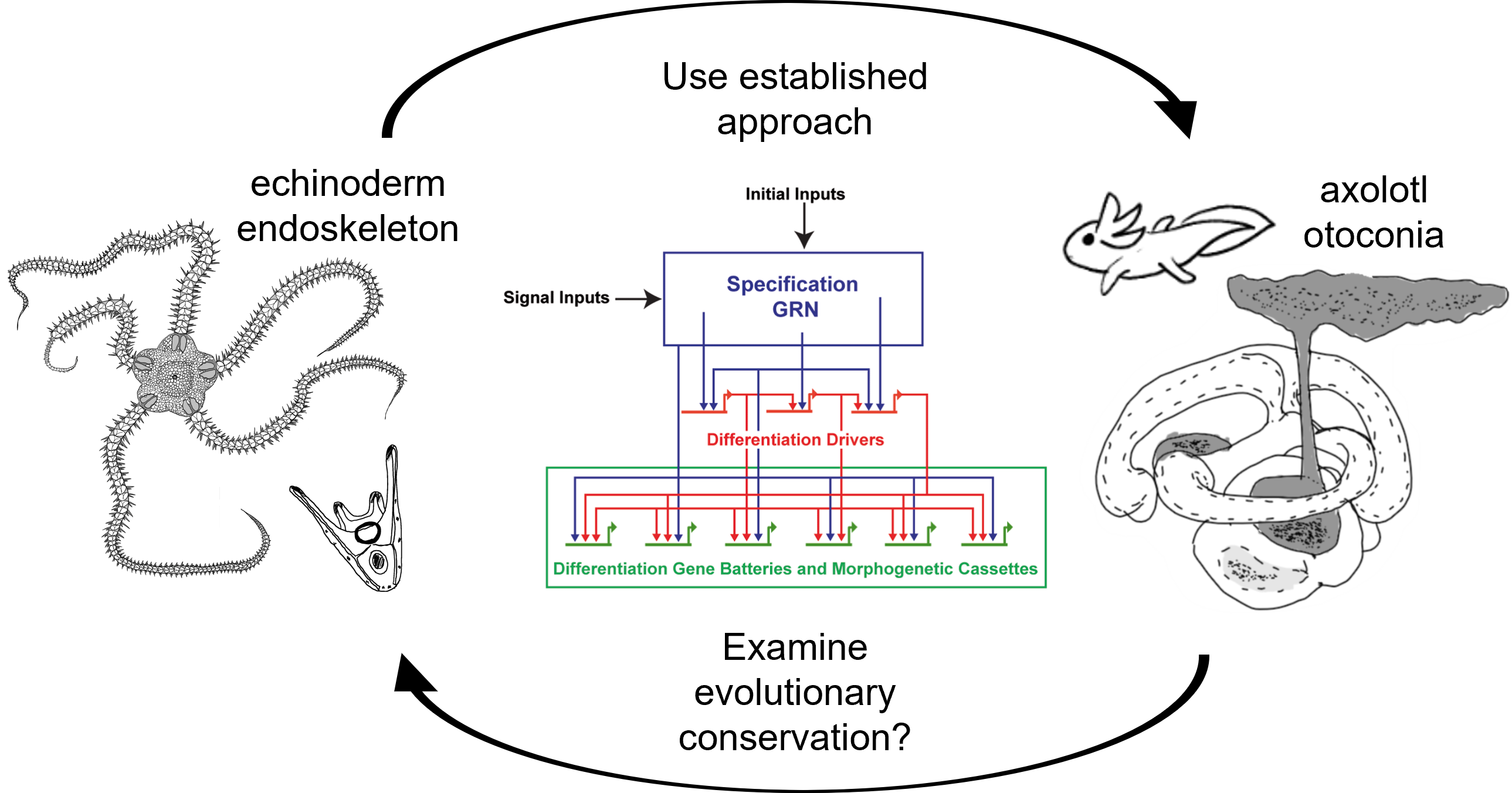
Using a combination of state-of-the-art omics approaches (spatial transcriptomics, multiomics and proteomics) we will build a scaffold of a gene regulatory network driving the formation and regeneration of otoconia in the axolotl. We will then use cis-regulatory element predictions, functional perturbation experiments and spatio-temporal gene expression validation to begin untangling the connections between the identified nodes. Our long-term goal is to conduct cross-species comparison studies to study evolution of calcium carbonate biomineralization in deuterostomes.
Restoring balance - organism-wide effects of loss and regeneration of otoconia in the axolotl
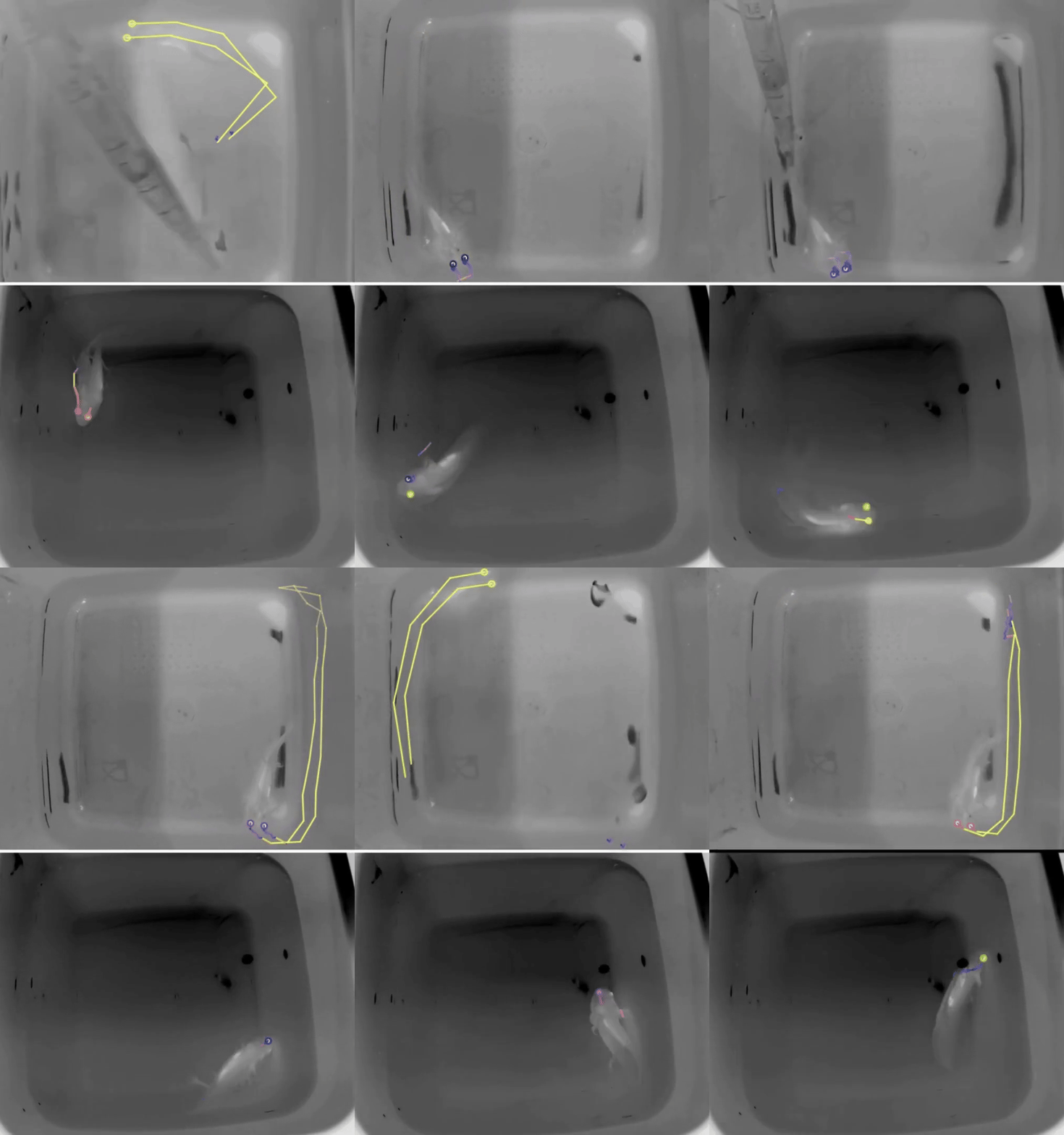
Otoconectomy in the axolotl leads to a pronounced swimming phenotype where the animals swim in a rotating manner. Regeneration of otoconia restores correct gravity sensation and balance. Using behavioural analysis and electrophysiology we will study how the axolotl recovers the correct neuronal connectivity and balancing locomotion after regeneration of the biocrystals.